
TPE car mats have become increasingly common in both the automotive aftermarket and OEM supply chain. Their durability, flexibility, and ability to be molded into vehicle-specific shapes have made them increasingly popular in the car mat market.
However, not all TPE car mats are manufactured to the same standard.
Two TPE car mats may look similar in photos, but their quality and performance can vary significantly. Factors such as material consistency, odor, fitment, and durability are closely related to the manufacturing process, including material selection, mold design, cooling, and quality inspection.
For B2B buyers, understanding the TPE car mat manufacturing process can help them assess supplier capabilities and make more informed sourcing decisions.
This guide breaks down the complete TPE car mat manufacturing process and highlights what B2B buyers should check at each stage.
Raw Material Selection and Preparation
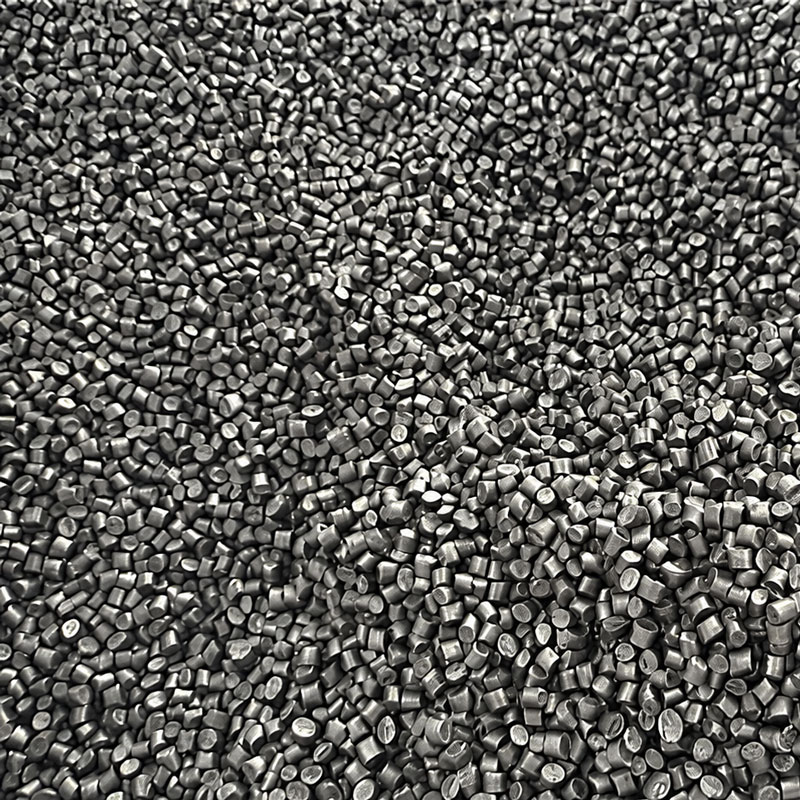
The manufacturing process begins with TPE pellets.
TPE, or Thermoplastic Elastomer, is not one single material. It refers to a family of materials that combine the processing characteristics of thermoplastics with the flexibility of elastomers.
For automotive floor mats, formulations may include thermoplastic elastomers combined with polyolefins, plasticizers, stabilizers, pigments, and other additives. This depending on the required hardness, flexibility, odor performance, temperature resistance, and appearance.
1. Virgin vs. Recycled TPE
One of the first questions buyers should ask is whether the product uses virgin TPE, recycled material, or a blend.
Virgin material generally provides better consistency in:
- Color
- Density
- Hardness
- Odor
- Mechanical properties
- Batch-to-batch performance
Recycled content can reduce material costs, but its performance depends heavily on the quality control of the recycled material.
For B2B buyers, the important issue is not simply whether recycled content is present. The key question is whether the supplier can demonstrate consistent material specifications and traceability.
2. Material Preparation
Before molding, raw materials must be stored and prepared according to the compound requirements.
Depending on the TPE formulation, preparation include drying, blending, color matching, and controlled feeding into the molding equipment.
Poor material preparation can contribute to problems such as:
- Surface defects
- Inconsistent color
- Voids
- Odor variation
- Unstable molding performance
Premium TPE car mat manufacturers typically monitor incoming material specifications and maintain batch records to improve traceability.
Vehicle Scanning and Product Design
For custom-fit TPE car mats, manufacturing does not begin at the injection molding machine.
It begins with accurate vehicle data.
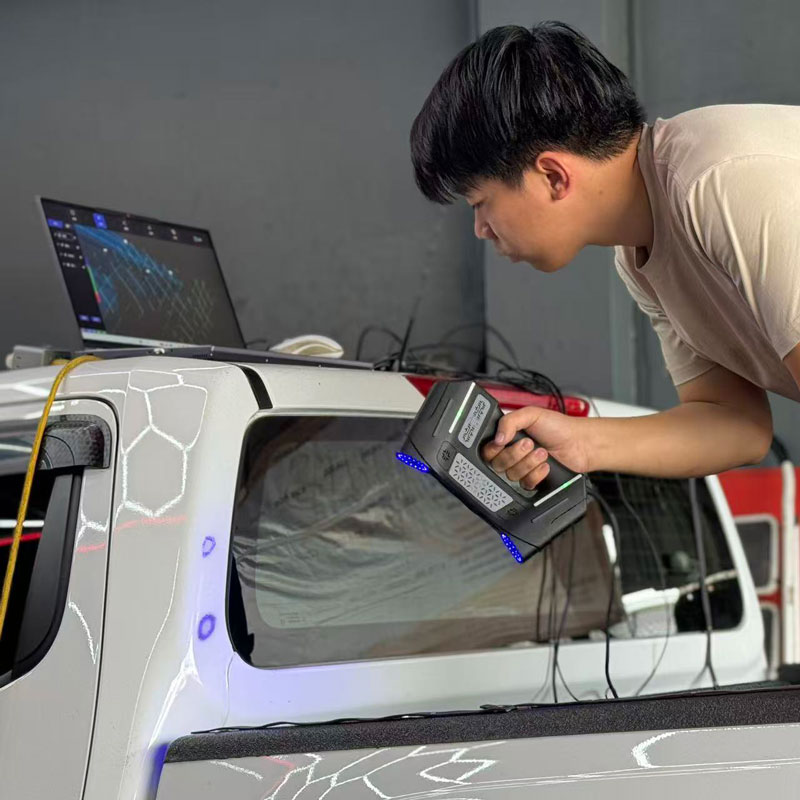
1. 3D Vehicle Scanning
Vehicle-specific floor areas can be captured using 3D scanning equipment or existing digital vehicle databases.
The purpose is to reproduce important areas such as:
- Floor contours
- Door-side edges
- Seat rail positions
- Pedal areas
- Factory anchor points
- Center tunnel geometry
Accurate scanning is especially important for high-wall or full-coverage TPE car mats. Because even relatively small dimensional errors can affect the actual installation and fitment.
2.CAD Design
The scan data is converted into a CAD model.
Engineers can then design:
- Mat boundaries
- Raised side walls
- Water channels
- Anti-slip textures
- Heel protection areas
- Logos
- Anchor holes
- Surface patterns
At this stage, manufacturers also need to consider manufacturability.
A visually attractive CAD design does not automatically translate into a stable molded product. Engineers must consider the wall thickness, draft angles, material flow, shrinkage, and cooling behavior before beginning the tooling process.
Mold Design and Tooling
Once the product design is approved, a production mold must be developed.
Mold quality is one of the most important factors affecting the final TPE car mat.
High-quality molds are precision-machined according to the CAD model and designed to control material flow and cooling across the entire part.
Why Mold Precision Matters
Poor tooling can result in:
- Uneven thickness
- Warpage
- Sink marks
- Poor texture definition
- Inaccurate edges
- Inconsistent raised walls
- Fitment problems
Cooling channel design is particularly important.
TPE naturally shrinks as it cools. Uneven cooling across a large floor mat can create internal stress, leading to warping or changes in its dimensions.
Tooling Lead Time
New vehicle-specific designs require more time for mold development than simple logo or packaging changes.
Lead time depends on factors such as:
- Product dimensions
- Mold material
- Design complexity
- Number of cavities
- Prototype requirements
- Tooling revisions
If a supplier offers an unusually short tooling lead time, buyers should confirm what is included in the estimate.

Thermoforming
Thermoforming is a key forming stage in the TPE car mat manufacturing process.
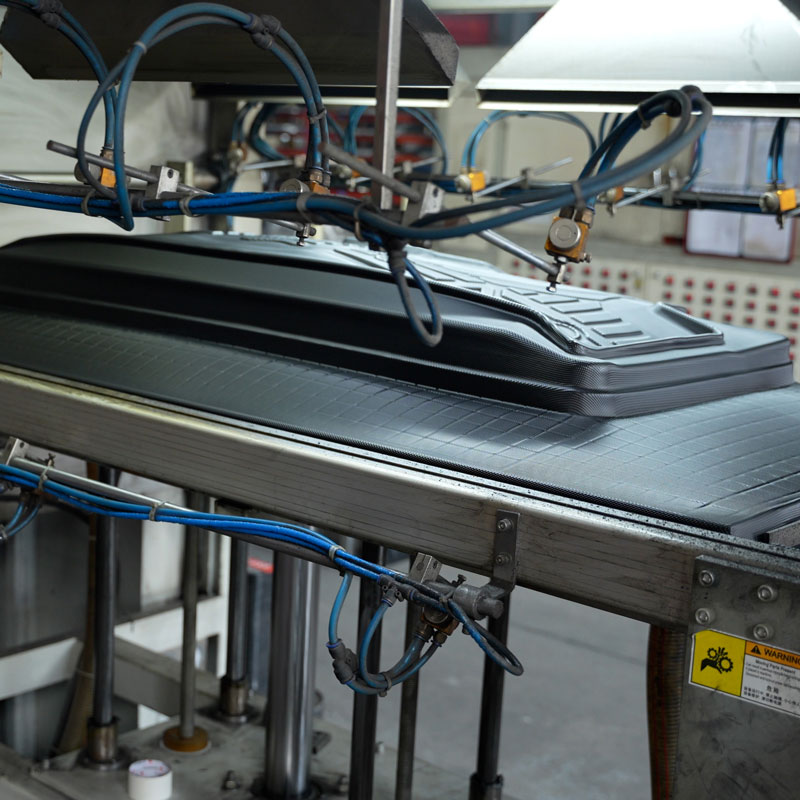
During thermoforming, a TPE sheet is heated to a suitable forming temperature and shaped over a mold using vacuum pressure or other forming methods. The material takes the shape of the mold, creating the contours, raised edges, channels, and other functional features of the car mat.
For vehicle-specific TPE car mats, thermoforming helps manufacturers produce products with consistent shapes and customized fitment for different vehicle models.
A. The Thermoforming Process
The thermoforming process generally involves the following steps:
Sheet Heating: The TPE sheet is heated evenly until it reaches the required forming temperature.
Mold Forming: The softened sheet is positioned over the mold and formed to match its contours, typically using vacuum pressure.
Cooling: The formed material is cooled to help stabilize its shape and dimensions.
Trimming: Excess material is removed to achieve the required outline and edge profile.
Dimensional Inspection: The finished mat is checked for shape accuracy, edge consistency, and fitment requirements.
B. Important Thermoforming Parameters
Thermoforming quality depends on the TPE material grade, sheet thickness, mold design, equipment, and product geometry. Manufacturers must control several key process parameters to maintain consistent product quality.
| Process Parameter | Why It Matters |
|---|---|
| Sheet Heating Temperature | Affects material flexibility, formability, and the risk of overheating. |
| Heating Uniformity | Helps prevent uneven stretching, inconsistent thickness, and surface defects. |
| Vacuum Pressure | Helps the softened sheet conform to the mold’s contours and surface details. |
| Forming Time | Influences how completely the material takes the required shape. |
| Cooling Time | Affects dimensional stability, warpage, and shape retention. |
| Sheet Thickness | Influences forming behavior, final wall thickness, and product durability. |
| Mold Design | Determines the mat’s contours, raised edges, channels, and overall fitment. |
Insufficient heating or uneven temperature distribution can result in incomplete forming and inconsistent thickness. Excessive heating or improper cooling may cause deformation or dimensional variations.
Careful control of these parameters helps manufacturers maintain consistent quality across production batches.
Cooling and Deformation Control
Cooling may appear to be a simple waiting stage, but it plays an important role in dimensional stability.
Large automotive floor mats contain different wall heights, channels, corners, and surface structures. These areas do not necessarily cool at identical rates.
If the process is poorly controlled, the finished mat may:
- Curl at the edges
- Twist
- Lose dimensional accuracy
- Fit poorly inside the vehicle
- Deform during storage
A well-designed mold, stable process parameters, and sufficient cooling time help reduce these problems.
Trimming and Edge Finishing
After molding, excess material or flash may remain around parting lines and edges.
The TPE mat therefore moves into trimming and finishing.
Depending on the product and production system, manufacturers may use:
- Manual trimming
- Precision dies
- CNC-guided cutting
- Waterjet cutting
- Other dedicated trimming equipment
The appropriate method depends on product geometry and factory configuration.
What Good Trimming Looks Like
Finished edges should be:
- Smooth
- Consistent
- Free from sharp burrs
- Properly aligned with the designed contour
- Free from excessive flash
Poor edge finishing can make an otherwise acceptable mat look inexpensive and may also affect installation.
Buyers should therefore inspect not only the main visible surface but also the perimeter and underside of samples.

Surface Features and Secondary Processing
Depending on the TPE car mat design, additional features may be integrated during molding or added through secondary processes.
A.Surface Textures and Water Channels
Patterns such as:
- Diamond textures
- Honeycomb structures
- Linear channels
- Raised grids
can be molded directly into the surface.
These designs are not purely decorative. Depending on their geometry, they can help manage water, mud, sand, and other debris.
Sharp and consistent texture reproduction generally depends on accurate tooling and stable molding conditions.
B.Anti-Slip Structures
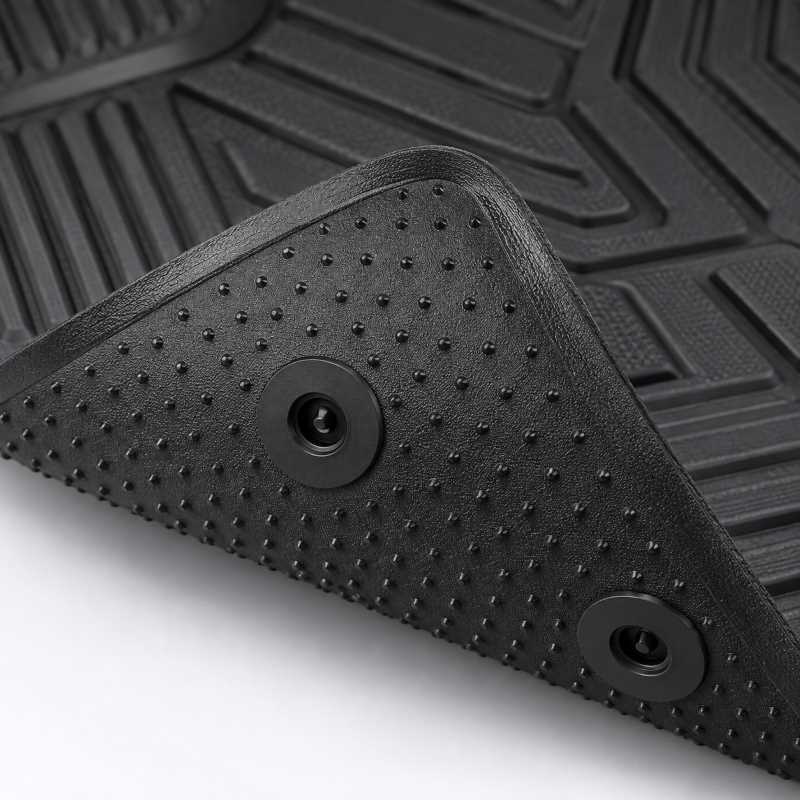
The underside of a TPE mat may include molded anti-slip textures, spikes, or other retention structures.
Vehicle-specific mats may also incorporate factory-compatible retention points to reduce movement during use.
C.Branding
For private-label programs, manufacturers may offer:
- Molded logos
- Embossed logos
- Metal badges
- Rubber labels
- Custom color elements
- Customized packaging
Logo material and attachment method should be evaluated carefully, particularly for products exposed to high cabin temperatures.
Quality Control and Testing
Quality control should not begin only when production is finished.
A stronger manufacturing system includes inspection throughout the production process.
A.Dimensional Inspection
Critical dimensions may be checked against CAD data, templates, gauges, fixtures, or other measuring equipment.
Important inspection points include:
- Overall dimensions
- Raised wall height
- Anchor locations
- Pedal clearance
- Edge contours
- Vehicle contact points
For vehicle-specific mats, fitment testing is particularly important because dimensional accuracy directly affects the end-user experience.
B.Visual Inspection
Inspectors typically look for defects such as:
- Warpage
- Sink marks
- Voids
- Discoloration
- Incomplete filling
- Surface inconsistencies
- Excess flash
- Damaged edges
C.Material Performance Testing
Depending on customer specifications and target markets, tests may cover:
- Shore hardness
- Tensile strength
- Elongation
- Compression behavior
- Heat aging
- UV resistance
- Low-temperature flexibility
- Odor
- VOC emissions
Automotive buyers may also specify particular test methods or third-party laboratory requirements.
D.Odor and VOC Control
Odor is especially important for interior automotive accessories.
A floor mat may meet dimensional requirements but still create complaints if it releases an unpleasant smell inside a closed vehicle.
For this reason, buyers targeting stricter markets should discuss VOC and odor requirements before mass production rather than waiting until the final inspection.
Customization and OEM Capability
Not every supplier offering a custom logo is a full OEM manufacturer.
Customization capabilities can generally be considered at several levels:
Level | Typical Capability |
White Label | Existing mat design with customized branding or packaging |
Semi-Custom | Existing product platform with customized colors, logos, packaging, or selected features |
Full OEM/ODM | Vehicle scanning, CAD development, mold development, prototyping, testing, and mass production |
How to Evaluate a TPE Car Mat Manufacturer
Understanding the manufacturing process becomes much more valuable when it is converted into a supplier evaluation system.
When comparing factories, buyers should look beyond unit price and ask how the supplier controls each production stage.
Before a Factory Audit
Check:
- Material specifications and available test reports
- Quality management certifications relevant to your project
- VOC and odor testing capability
- Vehicle database and product development capability
- Monthly production capacity
- Main production equipment
- OEM/ODM capabilities
- Sample development process
Always clarify whether quoted capacity represents one product line, one SKU, or total factory capacity.
During the Factory Walkthrough
Pay attention to the actual production environment.
A.Raw Material Area
Check whether:
- Materials are clearly identified
- Lots are traceable
- Storage conditions are controlled
- Different materials are properly separated
B.Production Area
Observe:
- Number and type of molding machines
- Mold condition
- Process stability
- Cooling procedures
- Production records
- Handling of defective parts
C.Trimming and Finishing Area
Look for:
- Edge consistency
- Excessive manual rework
- Burrs or flash
- Dedicated trimming equipment
D.Quality Inspection Area
Ask to see:
- Inspection standards
- Measuring equipment
- Checking fixtures
- Inspection reports
- Defect records
- Corrective action procedures
E.Packaging Area
Check whether finished mats are protected from deformation, scratching, dust, and incorrect labeling.

Final Thoughts
TPE car mat manufacturing is much more than melting plastic and pressing it into a vehicle-shaped mold.
The final product is the result of a connected manufacturing system:
Raw Material → Vehicle Scanning → CAD Design → Mold Development → Molding → Cooling → Trimming → Finishing → Quality Control → Packaging
A weakness at any stage can affect the finished mat.
Poor material control may lead to odor or inconsistent performance. Inaccurate scanning or tooling can create fitment problems. Aggressive cycle-time reduction can cause deformation. Weak inspection can allow defective products to reach customers.
For B2B buyers, understanding the manufacturing process therefore serves two purposes.
First, it helps explain why TPE mats from different suppliers can vary significantly in price and quality.
Second, and more importantly, it gives buyers a practical framework for evaluating a TPE car mat manufacturer before committing to a large order.
Instead of asking only:
“What is your price?”
buyers can ask:
“What material do you use?”
“How do you control dimensional accuracy?”
“How do you develop molds for new vehicle models?”
“Which production stages are completed in-house?”
“How do you test odor, fitment, and deformation?”
“How do you trace quality issues back to a production batch?”
The answers to those questions reveal much more about a supplier than a quotation alone.